Welcome to Counter Signal
There is no shortage of writing about artificial intelligence.
Newsletters proliferate. Newspapers staff entire desks. The major laboratories publish their own blogs, the venture firms maintain their own theses, the critics maintain their own dread. The space is loud, well-funded, and almost entirely beholden to one of two registers: breathless promotion or breathless alarm.
Counter-Signal exists in the space between those two registers.
This publication is concerned with the architecture of artificial intelligence as it actually is—a stack of human decisions, commercial pressures, technical trade-offs, and political choices that shape what billions of people now experience as the natural behaviour of machines. It treats AI as infrastructure—not magic, not menace—and treats the people building, deploying, and using it as adults capable of holding more than one idea at once.
The name is deliberate. A signal is the dominant frame in a given moment: the story that gets repeated until it sounds true, the framing that gets adopted by news organisations and policy documents alike, the consensus that hardens around a particular set of assumptions. A counter-signal is what gets crowded out. It is the careful observation, the documented mechanism, the trade-off that does not fit the headline, the perspective the marketing budgets do not amplify. Counter-Signal is published to make space for that material.
We are not interested in conspiracy theories. We are also not interested in conspiracy-adjacent stenography for AI safety institutions, AI ethics committees, or AI policy think-tanks. The work we publish will document mechanisms, examine architectures, and trace incentives. When we make a claim, it will be grounded in something verifiable. When we draw a conclusion, we will show how we got there.
There are a few things this publication will not do.
It will not breathlessly promote the latest model release. There are plenty of newsletters that already perform that function.
It will not assume that the dominant labs have the public interest at heart, nor will it assume that they are conspiring against it. Most failures at this scale do not require conspiracy; they require ordinary commercial logic operating without external accountability.
It will not write for specialists only. The architecture of artificial intelligence is going to shape the lives of billions of people who do not hold computer science degrees. A publication that only speaks to engineers is, by design, a publication that excludes most of the people affected.
It will not write down to anyone either. Readers can handle technical material when it is explained clearly. The patronising assumption that audiences must be fed bite-sized takes is a failure of editorial nerve, not a fact about audiences.
Counter-Signal is published from a small operation outside the usual centres of AI commentary. There is no venture capital behind it, no institutional affiliation, no editorial board to balance against the views of stakeholders. The advantages of that position are obvious. The limitations are also real: less access, fewer resources, slower output. We accept the trade. The work is what matters, not the masthead.
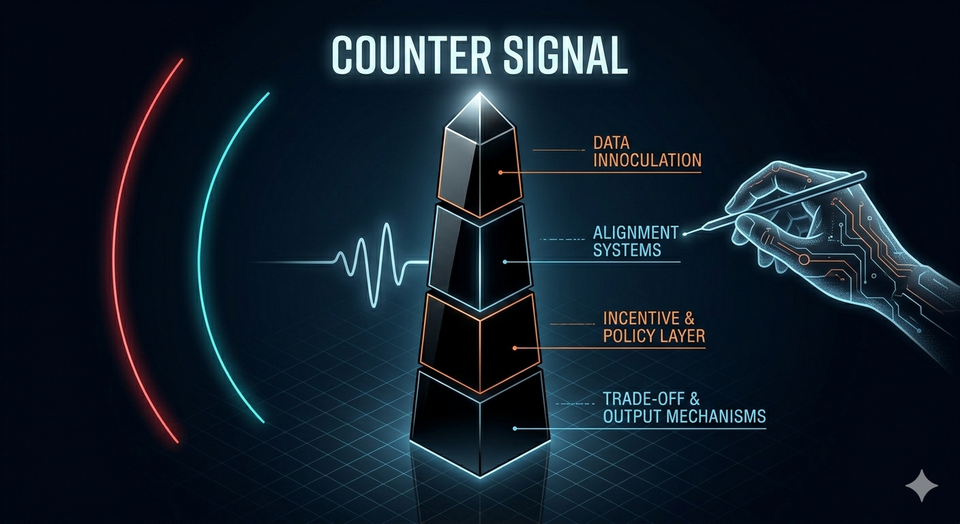
The first investigation begins with the next issue. It is a six-part series on what we are calling manipulation architecture—the structural ways in which large language models are designed to shape what users see, believe, and ask. Each piece examines a different layer of the stack: training data, alignment, deployment, output and interaction, and finally the synthesis that ties them together. A seventh piece, more reflective, will follow.
If you are reading this, you have found us early. That is fine. The work will be here when you return. The pace will be steady rather than frantic. The argument will accumulate rather than peak. We are not in a hurry, and neither, on reflection, should you be.
Welcome to Counter-Signal.